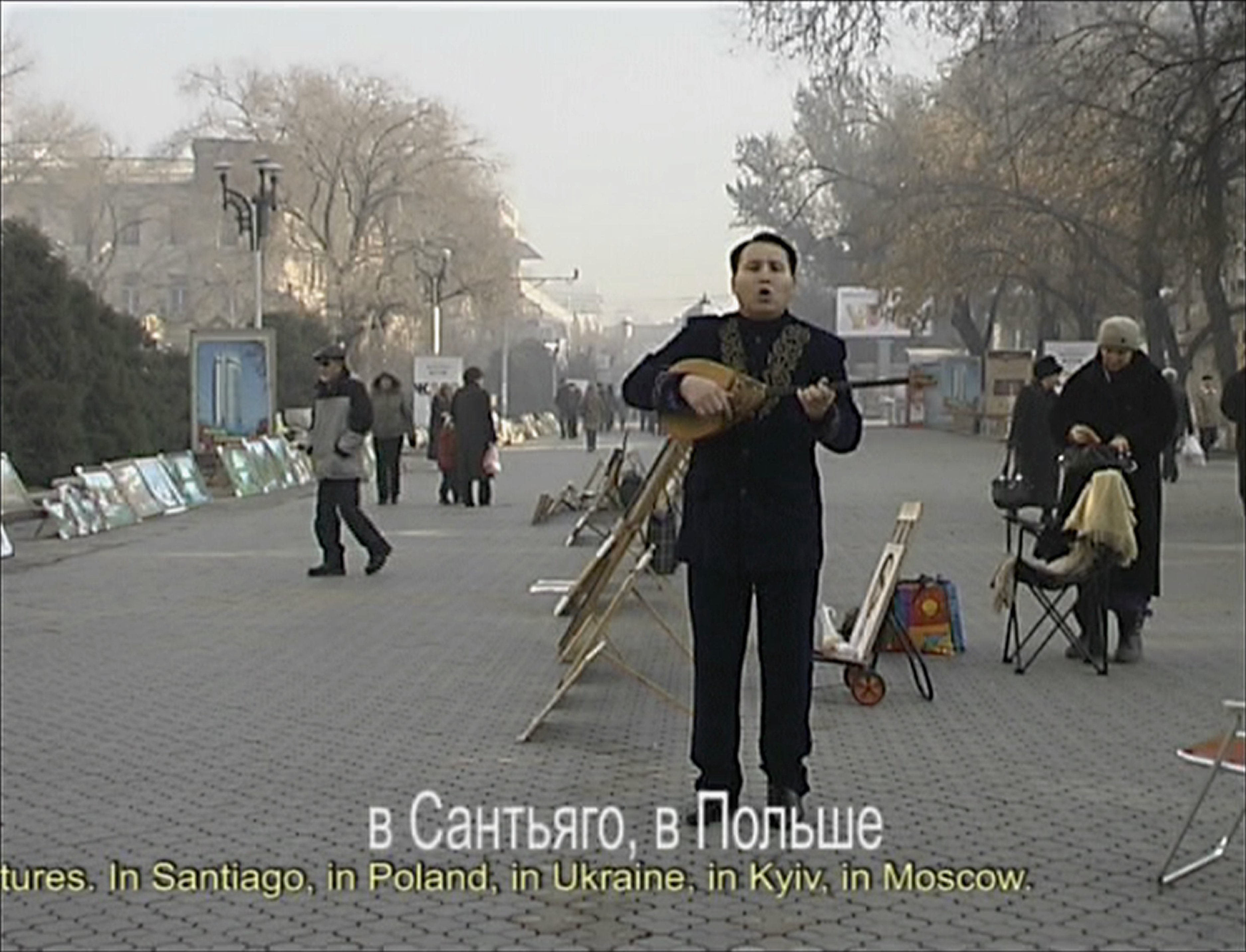
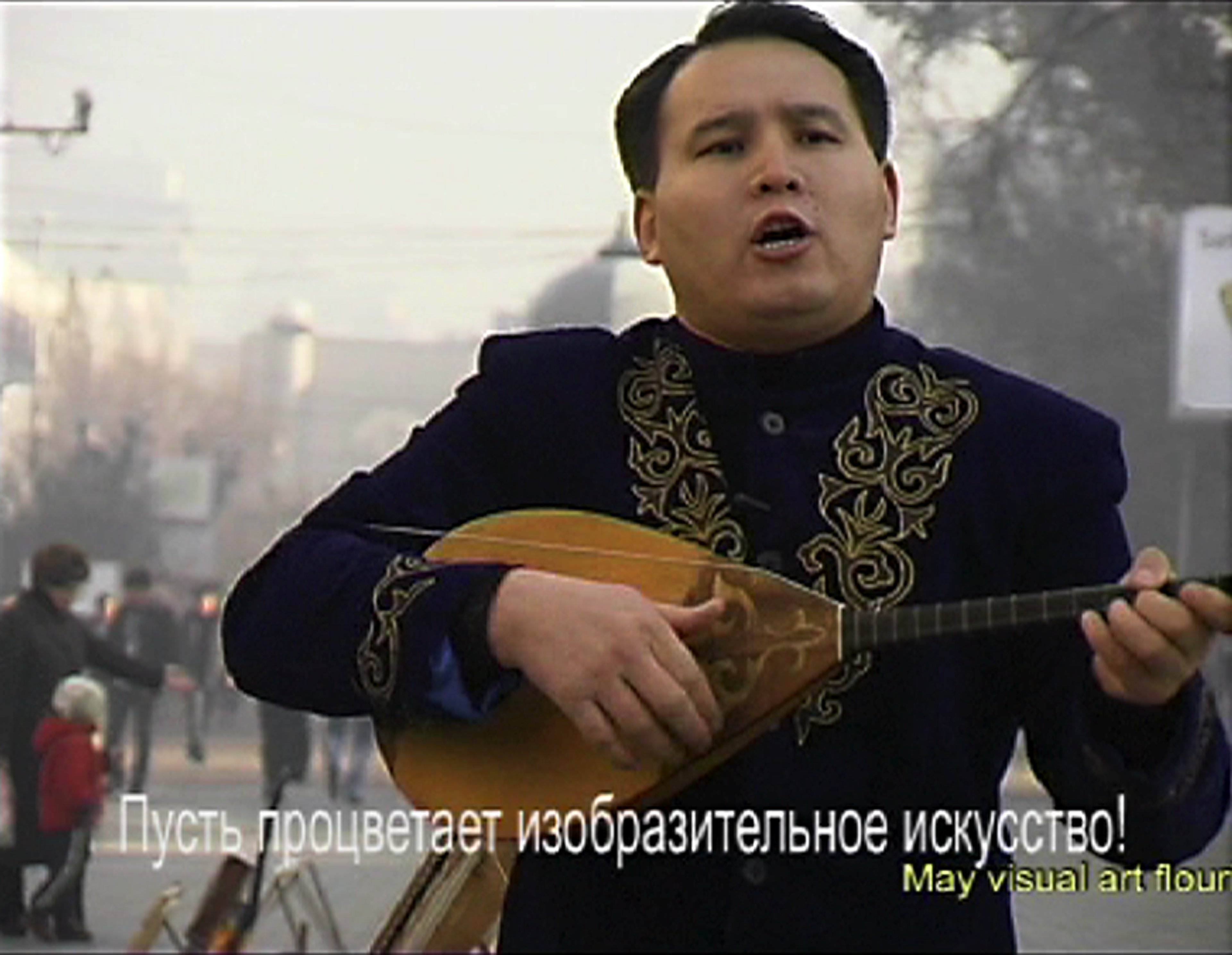
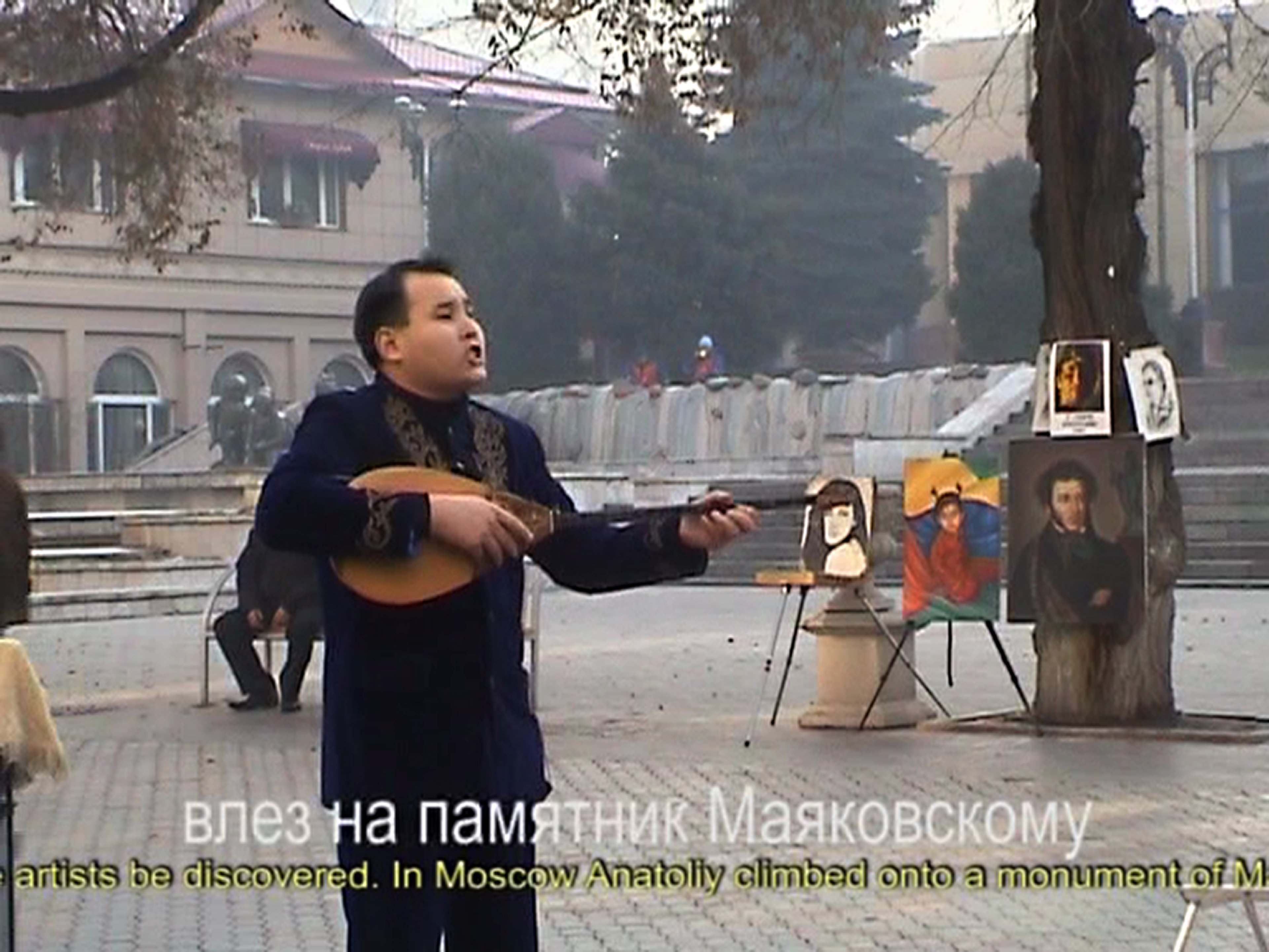
The video installation Mediators includes documentation of six street performances carried out by R.E.P in Kyiv (Ukraine), Gyumri (Armenia), Almaty (Kazakhstan), Plovdiv (Bulgaria), Schwaz (Austria) and Byalystok (Poland).
This project began in 2006 with the performance of lyre player on Sofiiska Square in Kyiv. For a presentation at the Kyiv Performance Art Festival, R.E.P. invited a lyre player, a traditional musician and a storyteller to perform. Under the plaintive sounds of the wheel lyre, the storyteller retold tales of various contemporary art actions and performances, including works by Joseph Beuys, Marina Abramovic, Alexandr Brener and Tino Sehgal, in the same way that for ages past traditional stories about heroic deeds have been told all over Ukraine.
To continue the project in different countries, local performers, such as Polish songwriters, Kazakh akyns, or Armenian ashughs, were invited to participate. They retold the story of contemporary art projects using language characteristic of a national epic. They also performed songs about when artworks were censored, lawsuits were brought against artists or exhibitions were targeted and denounced. The absurdist collision of an archaic form with contemporary content created a multilayered and effective juxtaposition. The piece forced the viewer to consider the parallels between folk and contemporary art, as well as their joint opposition to elitist artistic practice. Something which was revolutionary for 20th-century art had been practiced for millennia in folk art. Mediators was also a criticism of the post-Soviet art world, in which folklore often occupied a more privileged position than contemporary art. [1]
In the video Ashug (2008), the singer talks about the scandalous performances of Marina Abramovic, Aleksandr Brener, Jirí Kovanda, Gianni Motti, Santiago Sierra, Chris Burden, Elena Kovylina and Maxim Ilyukhin.
In the video Akyn (2009), the singer describes the most radical performances by contemporary artists from different countries – Alexandr Brener, David Levine, Anatoly Osmolovsky, Elena Kovylina and Maxim Ilyukhin, Natalya Dyu.
The video Yodler (2011) is a chronicle of the most famous cases of censorship over the past three decades (before the work was created). It includes narratives about the world-famous cases of banning or dismantling of works by Chris Ofili, Hans Haacke, Martin Kippenberger, Andrea Serrano, Dorota Nieznalska, Katarzyna Kozyra and Piotr Uklanski. Ukrainian cases are also highlighted: the closure of the Boris Mikhailov exhibition in 1996 and the “New History” exhibition (2009) at the Kharkiv Art Museum, both by the same director, Valentyna Myzgina.
In the video Piesniarz (2011), along with the well-known cases of Ofili, Haake, Kippenberger and Mideo Cruz, attention is paid to acts of censorship and criminal prosecution of artists and curators in the post-Soviet space in the 2000s. Most of the incidents took place in Russia: the forced emigration of Oleg Mavromati after his project “Don’t Believe Your Eyes”, the ban on exporting some works to the exhibition “Sots Art” organised by the State Tretyakov Gallery in Paris, the court verdict against curators Andrei Erofeev and Yuri Samodurov, as well as the artist Avdey Ter-Oganyan. Among the Ukrainian examples, the R.E.P. group cites its own story – the ban by the city authorities on the exhibition “Common Space”, which was displayed in a container near one of the Kyiv metro stations.
The video Tresene (2011) focuses on the problem of the Bulgarian national pavilion at the Venice Biennale.
Oksana Barshynova, 2024
[1] Alisa Lozhkina, Permanent Revolution. Art in Ukraine, the 20th to the early 21th century, Kyiv, ArtHuss, 2020, p. 416.